Wednesday, 8 July 2015

Mexico's Filarmónica wow GLive!

The audience at GLive rose to their feet in raptuous applause last night as the Orquesta Filarmónica de México concluded the 2nd night of their first ever UK tour with a rousing rendition of Moncayo's riotous Huapango.
With a programme that included a vibrant mix of Mexican/Spanish compositions intermingled with more traditional classical favourites, the orchestra's enormous dexterity and talent were shown at their very best. Jan Latham-Koenig conducted this passionate group of musicians whose string section in particular played with incredible precision and confidence.


Two compositions by Arturo Marquez were particularly rousing, indeed I found it hard to stay in my seat during Danzón No 2, one of the orchestra's signature works. Márquez is perhaps Mexico's best-known contemporary composer and his lively pieces draw on Creole dance traditions of Cuba as well as complex rhythms. In Danzón No 2, some surprising staccato sections for the violins combine with sliding brass and jazzy percussion to create wonderful, almost hypnotic, mix of pulse and melody.
In complete contrast, The Lark Ascending brought absolute quiet to GLive. Not a pin dropped as Tasmin Little drew the sweetest of notes from her violin; we were effortlessly swept away to blue skies and the innocence of summer as she connected completely with her beautiful Guadagnini violin, but equally important, never forgot the importance of her fellow musicians. Tasmin has won many awards, received an OBE and achieved international fame with her fine playing - it was an absolute honour to see her play at GLive.
It was also a privilege to see painist Jorge Federico Osorio, who opened the second half of the concert with an incredible rendition of Gershwin's Rhapsody in Blue. With the grand piano moved to the front of the stage, we had a fine view of his hands as they flew across the keyboards, backed by a tremendously rousing sound from the orchestra and perfectly timed percussion, so important to this popular and uplifting jazzy number.
Also in the hot seat was Rodrigo Garibay, a fine saxophonist and clarinettist from Mexico City, who played alto sax in tonight's rendition of Adiòs Nonino, composed by Argentine-born Astor Piazzolla.

This was the type of orchestra and performance that fully confirms the importance of GLive as a great concert venue. The audience were fully appreciative of the distance travelled by this large group of fine musicians who make up OFUNAM. One of the most significant and exciting projects initiated by the National University of Mexico, over 100 wonderful musicians took command of the venue and it was an absolute pleasure to welcome them to Surrey as part of their UK tour.

Further dates:
July 8th Basingstoke, The Anvil
July 9th London, Cadogan Hall
www.ofunam.unam.mx

Friday, 5 June 2015

RA Summer Exhibition - a celebration of colour


Viewing the Summer Exhibition normally starts once you enter the magnificent doors into the first room, the Central Hall. Not so this year; in his desire to involve the actual building itself and not just the walls, curator Michael Craig-Martin decided to include the stairs. Hence those wide wooden stairs, so familiar to all RA devotees as the first foray into every exhibition, have been painted in vibrant stripes by Jim Lambie. It felt almost sacrilegious to walk on them to reach the main show.
Colour was also on Craig-Martin’s mind when he curated this year’s Summer Exhibition. But not just on the canvases and sculptures - a few of the rooms have been drenched in a rich colour and the walls of the main gallery have been painted a vibrant pink. But won’t that detract from the colours of the actual artworks? - I hear you ask, but strangely it doesn’t, it somehow works with many of the canvases and the colours sing out more. Mississippi River Blues, a white ink and black wash painting by Richard Long, looks incredibly striking as the anchor point of Room ll and Craig-Martin’s own massive painting of a watch on turquoise positively leaps off the wall.
Thankfully, not every room is violent pink though - the Central Hall is turquoise and most rooms are conventionally white which is more restful on the eye. I noticed this year how wonderfully bright the Royal Academy galleries are, light floods in from ceiling windows and the hanging is far from over-crowded. In fact, there are some vast empty spaces which may be slightly irksome for those artists who were short-listed but didn’t make the final ‘hang’.
We were reminded at the start of the curator’s tour that the whole point of the Summer Exhibition is to raise money to fund the RA schools that are hidden in the depths below the main galleries, and this is the only graduate art school in England that does not charge fees. Now in its 247th year, the Summer Exhibition is the longest standing exhibition in the world and every year is wonderfully different.
This year’s hanging committee includes Royal Academicians: Norman Ackroyd, Olwyn Bowey, Gus Cummins, Jock McFayden - all familiar names whose own works are included and - what I love about this show - just casually mixed in with work by unknown artists and yet all hanging so together like old friends.
This year’s show deliberately includes artists of an ‘older’ generation, many of whom were acclaimed in their day but have slightly slipped under the radar. Good news for we the spectators, for these artists were creating in the hey day of abstract painting, experimenting with different styles and forms, and producing some wonderful work. 
The print room is particularly exciting this year - and Norman Ackroyd, who has overseen the room said he enjoyed the ‘astonishing level of work submitted, and the fascinating range of print methods.’ Printmakers are undoubtably on a roll right now, employing all sort of materials to create their images and enjoying mixing traditional techniques with new.
Most rooms have what Craig-martin calls an ‘anchor point’. In Room Vlll a huge, bluey painting of two ladies by the late Bill Bowyer dominates, in the friendliest of ways, the whole vast space. In Room lV, a mirrored work by Paul Hosking is deliciously opulent, take time to go right up to it and study the amazing refections of the room behind you. And be prepared for the joy of Grayson Perry’s fabulous, massive tapestry, ‘Julie and Rob’ in Room l - it will lift your heart with its sheer colour and Perry’s amazing devotion to his craft. 

Each time I visit the Summer Exhibition, I feel incredibly excited by the vast range of work. I seek out my own favourites - Ken Howard, Gus Cummings, Quentin Blake, Anita Klein, and I look for those less well known for their art - Una Stubbs does some wonderful watercolours. And every year I discover someone new who I hope will be there again the following year, such as Simon Wright or Mike Jones.
Apparently the average visitor to the Summer Exhibition spends 3 hours there - I warn you, that is not enough. Take your time, or simply go again another day - a different mood, different shoes - each time will offer a different, and very worthwhile, experience.

The RA Summer Exhibition 2015 runs from June 8 - August 16. www.royalacademy.org.uk

Friday, 30 January 2015

Spanish Civil War at Pallant House Gallery

If you think that provincial art galleries live in the shadow of those in major cities, think again. Pallant House Gallery in Chichester not only has some notable works of art in its permanent collection, it also stages outstanding exhibitions. Its current show, Conscience and Conflict: British Artists and the Spanish Civil War, is the first British exhibition devoted to British artists and their response to the Civil War and also examines the Spanish artists who influenced them. In this wonderful Queen Anne building, with its high ceilings and vast windows, we get space and time to see the artworks, a privilege sometimes lost in larger city galleries. We also learn about the ordinary people and the ways the Civil War affected them.
The conflict between the democratically elected Republicans and General Franco's Nationalist rebels stirred emotion across Europe. Over 2,500 recruits from Britain and Ireland joined 40,000 volunteers from 53 countries to fight in the Civil War - this was 1936-39, a precursor for the Second World War, and described by Hemingway as 'the dress rehearsal for the inevitable European War'. Romanticised by many as a 'literacy' conflict due the number of writers and poets who became involved, the war also inspired generations of artists to comment through their works of art. 
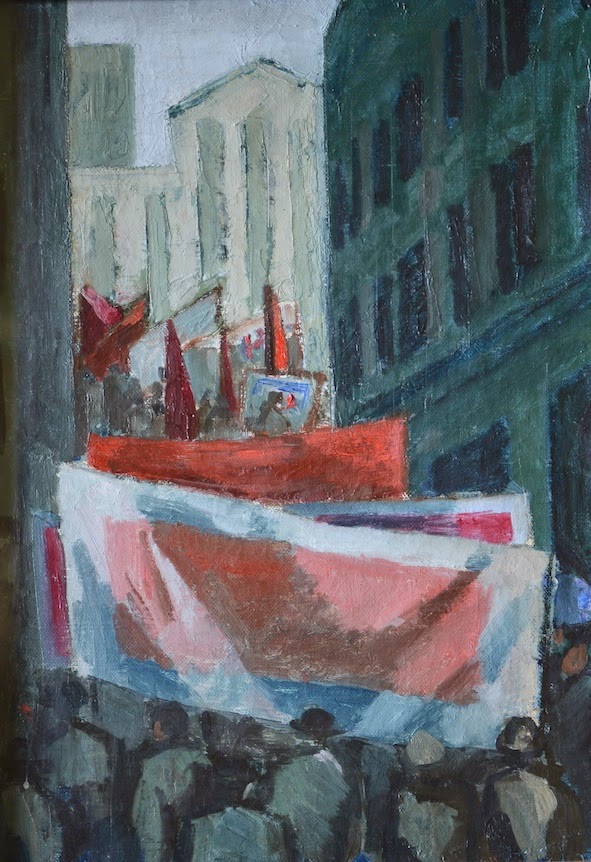
Artist Felicity Browne (1904 - 36) was the first British volunteer to die in battle. A month after arriving in Spain in August 1936, she was in a party sent to blow up a munitions train when she was fatally shot under enemy fire. It is incredibly moving to see the sketchbook found on her person showing delicate drawings of her fellow volunteers and the military. Equally poignant is a wonderfully atmospheric poster by Quentin Bell, 'May Day Procession with Banner'. Red banners held aloft by protestors sway as the crowd moves up a shaded alley into a sunlit square - the light and shade is almost menacing, quiet darkness with the possibility of hope at the end of the march. But the end result was tragic for Bell - just days after he painted the poster, his brother Julian, who had volunteered as an ambulance driver, was killed in Spain.


May Day Procession with Banner by Quentin Bell


Kauffer's Help Wounded Human Beings


Browne's untimely death prompted many artists to join the left-wing Artists International Association (AIA), which, since its founding in 1933, had attracted 600 diverse members, including Stanley Spencer, Barbara Hepworth, Alistair Morton, the Surrealists and the Bloomsbury Group. Through its exhibitions it raised money for the Republican cause. To get their message to a wider audience many artists moved to poster design and these are a wonderful part of the exhibition - striking, graphic and at times slightly disturbing - from Kauffer's gaunt El Greco face on a black background to the more delicate lithograph, For the Relief of Women and Children in Spain, by Frank Brangwyn, they bring home the despair of war.
The bombing of civilian targets in Spain was most chillingly felt in the Basque capital of Guernica, annihilated by Nationalists in 1937. The most famous artistic response to Guernica’s destruction was Picasso's Guernica. Now safely housed in Madrid's Reina Sofia and deemed too fragile to move, it has been recreated for this exhibition in a large textile banner created by a collective of artists since June 2013. Situated in the ground floor foyer of the gallery, it represents the passion felt by many groups, organisations and creative people about the Civil War.

Upstairs, this vibrant exhibition shows how every style and medium has been used to convey artists' messages against the Civil War. One moment we are struck by scarlet banners embroidered by British women and a menacing mask of Neville Chamberlain by surrealist F E McWilliam, and wowed by Picasso's actual Weeping Woman, - the next we are quietly humbled by a touching Hubert Finney illustration of a broken Spanish Prisoner of War, his eyes so touchingly conveying the suffering he has endured. 
This is a truly informative and meticulously researched exhibition curated by Simon Martin, Artistic Director at Pallant House, and many people will be surprised at the involvement of so many British artists in the Spanish Civil War. Hence it is an important date in any art diary. After a quick visit to the many other wonderful rooms at Pallant House with their various works of art, I left feeling certainly wiser and also visually richer. I will certainly make time to visit again before the exhibition ends next month.
Conscience and Conflict: British Artists and the Spanish Civil War is at Pallant House Gallery until February 15. www.pallant.org.uk @pallantgallery Tel: 01243 774557

And a bit about... Pallant House Gallery is a unique combination of an historic Queen Anne townhouse and contemporary extension, housing one of the best collections of Modern British art in the country, including important works by Auerbach, Blake, Caulfield, Freud, Hodgkin, Nicholson, Paolozzi, Piper and Sutherland. Widely acclaimed for its innovative temporary exhibitions and exemplary Learning and Community Programme, the Gallery has won numerous awards since re–opening in 2006.

Thursday, 29 January 2015

Edward Scissorhands - a cut above the rest

I loved Tim Burton's film of Edward Scissorhands - was it really 25 years ago? - such a touching tale of an innocent boy with his awkward scissors-for-hands. 
The endearing Edward, with his clinking blades has held a special place in my heart ever since so I was excited to see him on stage at last. And particularly this current production by New Adventures, as it is directed by the wonderfully creative Matthew Bourne. Having transferred to the New Victoria Woking following a sell out run at Sadlers Wells, my thoughts were with the cast on the first night. Moving location after a successful run must be physically and psychologically challenging for a show that relies heavily on tightly choreographed dances and careful timing.

It was totally enchanting from the first curtain. A beautiful set designed by Lez Brotherston transported us swiftly into a dark and mysterious house where the old professor quietly works on the creation of Edward and his temporary hands. Dark is done well by Bourne - there was not a sound to be heard from a gripped audience as the new Edward evolves, played so convincingly by Dominic North as he jerks and stumbles and gets used to his new limbs.  The silence is shattered when the house is broken into by intruders, Edward escapes in terror and finds himself amongst the quirky inhabitants of small town Hope Springs. Seen at first as a freak of nature, his endearing nature wins him friends and he find security when one family adopts him as their own. The plot is very simple, boy (with scissors) falls for local girl who already has bully boyfriend. Girl falls for the lovely, innocent Edward, romance tentatively ensues, bully gets hacked off an reacts badly until - well, I mustn't ruin the ending.Into this simple plot Matthew Bourne weaves a wonderful world of colour, music and high imagination. The set is one fantastic, gigantic animation with wonky houses, oversized doors, fluffy pink beds and stylised props. Costumes, also by Lez Brotherston, are wonderfully wacky and hair and make up are off the wall. What an incredible time the creative teams must have had with this production. 

Even the greatest costumes and props cannot diffuse timid dancing, but in this show, every character shone through - New Adventures is a massively talented troupe with confident dancers who look as if every show is their first exciting debut. One fantastic dance after another reveals incredibly tight choreography that gets the whole joint jumping. Dominic North's jerky, awkward, totally trusting Edward contrasts beautifully with Ashley Shaw as the delicate and absurdly cute love interest Kim. Etta Murfitt is vibrant and domestically gorgeous as the mother who welcomes Edward into her home. But - It is impossible to highlight all the 'stars' of this show as so many of the cast, however minor their part, are brilliant in their roles.Backed by a thumping good score written and conducted by Terry Davies, this is an entrancing production with enough feel-good factor to get me, and the scores of other people who rose to their feet with applause, through the rest of a long winter.  

Edward Scissorhands is at the New Victoria Woking until Saturday January 17th. Then touring the UK. Tour dates and tickets: http://new-adventures.net/edward-scissorhands/tour-dates


Saturday, 11 October 2014

7 Steps to heaven with Guildford Jazz

Guildford Jazz's 2nd gig in its new venue at Guildford Rugby Club last night started with 'So What' and ended with '7 Steps to Heaven'. I nearly jumped off my seat when trumpeter Martin Shaw announced the first Miles Davis tune of the evening - only that morning I had begun learning 'So What' in my double bass lesson. Destiny and fate knocking at my door I feel. But watching the skills of Marianne Windham on the bass, I realised that only true dedication and lengthy practise results in fine playing.

Marianne once again pulled together some amazing jazz names for a gig that started gently and ended with such a tremendous crescendo that half the room rose to their feet to applaud. Martin is one of the UK's leading jazz musicians and has that knack of playing completely effortlessly and with self-effacing calm. With an impressive musical CV that started with the trumpet at the age of 11, he continues to play jazz, pop and classical and, fortunately for today's young musicians, tutors the next generation of would-be trumpeters. He has worked with many leading jazz artists including Cleo Laine, John Dankworth, the BBC Big Band and 'pop' musicians including Sting, Jules Holland and Jamiroquai. A huge fan of Miles Davis, he peppered the tunes with anecdotes which made the evening even more enjoyable. Miles Davis was apparently instrumental in taking a new direction in jazz, moving away from the more frenetic sound of the Dizzy Gillespie school and introducing 'modal' music. He was the first jazz musician to improvise and compose according to modal structure; Kind of Blue is the definitive modal jazz album and Martin Shaw and the band played 3 smooth and melodic tracks from that album to ease us in gently.

Blue in Green was fabulously mellow and allowed pianist Robin Aspland the opportunity to give the first of many amazing, in fact truly amazing, solos on his keyboard. Robin also has the knack of looking uber relaxed, almost 'elsewhere' in fact, gazing happily around the room, barely looking at his keyboard yet producing the most complicated and beautiful sounds while the audience, and indeed the band, gaze on in wonder. Again he has played with many of the most famous UK and American singers and it is humbling that he, Shaw and others of their ilk, travel to Guildford to share their great musicianship.
Keeping step with Robin's intricate tunes was Marianne herself, a dedicated and talented bassist who works hard to enrich the Guildford jazz scene by inviting esteemed players to join her in the Surrey venues. However she remains one of the most modest players on the circuit; as a relative newcomer to the jazz world, she generously gives the floor to others but she is actually right up there with them! 
And talking of solos, the dark horse award of the evening went to drummer Sebastiaan de Krom who led us into a false sense of quietitude for the first few numbers, caressing the drums quietly with his brushes and allowing the occasional tinkle on the tambourine. But once the mellow sounds of  "Kinda Blue' had dwinded away, he threw himself into a Sonny Rollins number like a man that's had his arms tied all evening. De Krom teased every sound imaginable out of those drums - from whispering strokes and tinkling waterfalls to a thundering, rhythmic beat that stamped through my entire body and caused almost hysterical admiration from my fellow onlookers. Once again, De Krom delivers with an air of non-chalence that belies his incredible passion and talent - by the end of that unbelievable solo we were all mad for another drum roll.
Incredible jazz talent doesn't come lightly. Martin explained that Charlie Parker and fellow musicians were so incredibly good because they practised all the time, literally 7 nights a week every week, often doing 2 or 3 sessions a night. And they would tour for over a year, not even popping home for Christmas. Such devotion to learning an instrument, or many instruments, is nothing short of remarkable. It seems to me that the incredible jazz musicians that visit the Guildford jazz scene must also be putting in ridiculous of hours of practise. We are very grateful to them and this was another remarkable and lively evening - ending appropriately with '7 Steps to Heaven'. 

For all info about forthcoming jazz nights visit www.guildfordjazz.org.uk

Friday, 10 October 2014

Bennett double bill - crafted script and fine acting


An invite to a double bill penned by Alan Bennett at the Rose Theatre was an opportunity not to be missed. With 'spies' as the theme, although certainly not my Mastermind subject, it presented a good chance to learn something about a world I'd always wondered about. The two plays - An Englishman Abroad and A Question of Attributionshare common themes on the identities that the Cambridge spies, aka the Cambridge 4, had to adopt during their careers in espionage.
The first play tells of Guy Burgess's time spent in exile in Russia. A British-born Soviet spy who was active during World War Two and the Cold War, he fled to the USSR when he was warned of possible arrest in 1951. Alexander Hanson is truly fabulous in the role of Burgess in this Rose production. Louche, languishing but also charming he smacks of loneliness as he kicks around in his Moscow apartment, dreaming of fine suits and good food. He develops a friendship with his neighbour Coral, who is played with twinkling humour by Helen Schlesinger. Offering her supper which he then burns, Burgess shows extraordinary desire for the simple things he misses from dear old blighty, whisky and tomatoes seemingly all he now has to live on. He reminisces with Coral about England, but his allegiance to the country is tenuous " You see," he says, " I can say I love London. I can say I love England. But I can't say I love my country. I don't know what that means."
Alexander Hanson and Helen Schlesinger
Burgess never felt settled in Moscow, he sought solace in Russian lovers and drink and never bothered to learn Russian. In the end his alcoholism ravished his body and he died of drink related illness in 1963 aged 52. An Englishman Abroad is surprisingly gripping for play with little action. But the characters are endearing of course, Bennett's clever script is to be savoured. Sadly, many a precious line flutters by into the breeze as they simply tumble one after another, we are almost spoilt for choice. Words there are many, but I also admired the long silences afforded by Burgess and Coral - it takes brave acting just sit and simply stare. In this exiled environment, we truly get the ghastly feeling of waiting and utter ennui that Burgess must have experienced holed up in Moscow waiting for.....well, what exactly?
At the end of the play, Coral reminds the audience how very different the lives of spies today are to those in Burgess's era. He lived alone in exile; if he were alive today he would have written his memoirs and would most certainly be a guest on Desert Island Discs.
In A Question of Attribution we visit the world of Anthony Blunt, and this is an equally clever Bennett play, but drier without the antics of Burgess to lighten the plot. Michael Pennington is wonderful as Blunt, coping with lengthy and complex dialogue without faltering. He keeps his wits as the detective known as Chubb shows him slides of Old Masters interjected with endless slides of possible spies, challenging Blunt that he may have known them. Blunt was, like Burgess, openly gay and Julian Mitchell suggests in his play about spies, Another Country, that with homosexuality a crime at the time, gay people were practised at concealment and therefore were naturally inclined towards a life of espionage. Blunt was a little older than Burgess and others in their circle, and he became a kind of elder statesman. He spent the war years in intelligence and in April 1945 was appointed Surveyor of the King's pictures, (and then the Queen's) a post he enjoyed until 1972. When he was revealed as a spy there was naturally horror and embarrassment as he had been a frequent and welcome visitor to Buckingham Palace.
Bennett's use of the paintings is intriguing in this play, and a clever tactic as Blunt discusses the whole world of fakery and tries to unmask the 3rd man in a painting by Titian. It takes real focus to take in every line spoken in this extremely clever play, which is possibly over wordy and hot on detail. True Bennett fans I know will disagree! But I still enjoyed it and was grateful for a little humour brought by Helen Schlesinger who is superb and really rather cute as Her Majesty the Queen. 
All credit to Francis O'Connor's striking backdrops and Sarah Esdaile's assured direction which really bring these two plays to life. Single Spies is classic of the warm and confident productions put on by Rose Productions, and it's wonderful to see new life injected into the old spy stories that still fascinate, and occasionally shock us, today.
Single Spies plays at the Rose Theatre, Kingston until October 11. Box office www.rosetheatrekingston.org 0208 174 0090

    Thursday, 11 September 2014

    Fantastic new venue for Guildford Jazz

    Exciting times for Guildford Jazz last night as a packed house enjoyed the first night at their new venue. The Pavilion, at Guildford Rugby Club near Godalming, proved to be excellent in sound, atmosphere and parking which all bodes well for future gigs.
    Marianne Windham, who runs Guildford Jazz, gathered some amazing musicians for the opening night and the energy and talent throughout both sets gripped the crowd. Two amazing alto sax players - Alan Barnes and Tony Kofi - stunned with their range and musical talent, working together and separately, moving through compositions by Barnes himself and well known tunes by Duke Ellington and Miles Davis. Alan's droll sense of humour was an enjoyable addition to the introductions to various numbers, and also revealed itself in his composition, The Snail, a wonderfully uplifting bossa nova. Alan's CV is staggering and too long to list here but Pasadena Roof Orchestra, Humphrey Littleton, Stan Tracey and BBC bands all feature and of course, numerous awards. Tony Kofi is also mutli talented, a player of alto, britone and soprano sax as well as the flute. He has also won many awards and composed original music for his 10 piece group, the Afro jazz family, and his quartet and trio.


    Making up this dynamic quintet were John Turville on keyboards, Rod Youngs on drums and Marianne on double bass. John is an incredibly smooth pianist, rippling across the keys with ease, despite only having had 2 hours sleep! Marianne, who we should remember may not have played with these guys before, hit the fret board running - playing some incredibly complicated pieces and providing a very strong bass line to every number. Modest as ever, she attempted to keep her solo spots short, but Alan was having none of it and simply strolled away leaving her to delight the floor with another phrase or two. And last but far from least, Rod Youngs was simply one of the most mesmerising drummers I have seen. A quote from the Guardian once said, “Rod doesn’t so much hit the drums as massage them.. total mastery.” And that truly sums him up - he is totally immersed in his playing, moving from some very solid, incredibly rhythmic solos to gentle whispers with his drum brushes - totally hypnotic and wonderful to watch.
    Writing it down reminds me that it is all the more amazing that these guys, who play some major international venues, came all the way to Guildford to play at the The Pavilion - or 'Fleet' Alan kept calling it, with his tongue in cheek humour. But we all knew it was Guildford Rugby Club and I am sure most of the audience will be going back for more.

    The next gig at The Pavilion is on Weds October 8th - Martin Shaw plays Miles Davis.
    For details of all Guildford jazz gigs visit www.guildfordjazz.org.uk Twitter: @guildfordjazz

    The Pavilion
    Broadwater Sports Club
    Guildford Road
    Godalming
    Surrey
    GU7 3DH